
1. Enter Location Details
North positive (+), South negative (-)
Longitude affects local time but not Yantra angular dimensions.
2. Angular Calculations (Based on $\phi$ = --$^\circ$)
Location: --
Coordinates: ($\phi$ = --°, $\lambda$ = --°)
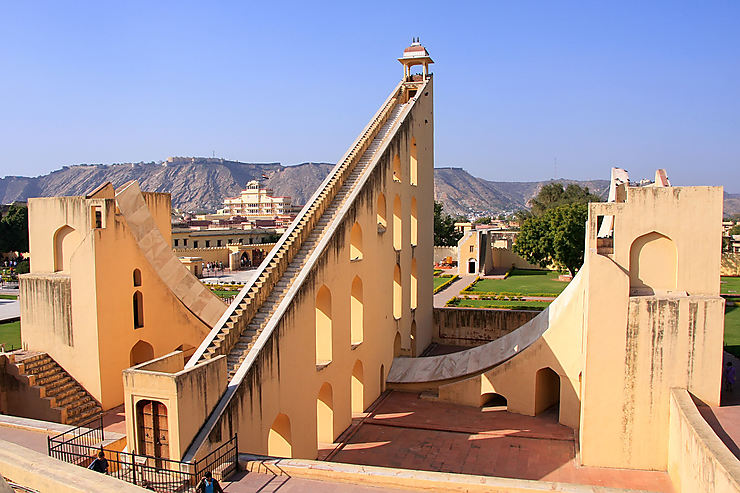
Samrat Yantra
The Supreme Instrument (Equatorial Sundial). Gnomon aligned with the Earth's axis.
Dimension is: Latitude $(|\phi|)$
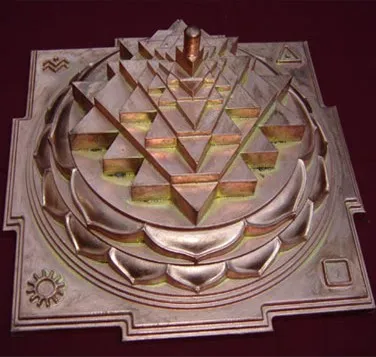
Dhruva-Protha-Chakra Yantra
Instrument for sighting the Pole Star (Dhruva) to confirm the local altitude of the celestial pole.
Dimension is: Latitude $(|\phi|)$
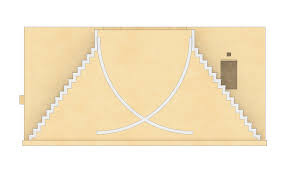
Dakshinottara Bhitti Yantra
The Meridian Wall. Measures max altitude. Key dimension is the height of the celestial equator at noon.
Dimension is: Co-Latitude $(90^\circ - |\phi|)$
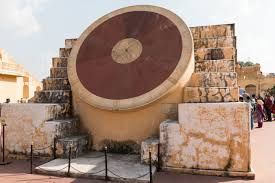
Nadi Valaya Yantra
The Equatorial Ring Dial. The plates must be parallel to the celestial equator's plane.
Dimension is: Co-Latitude $(90^\circ - |\phi|)$
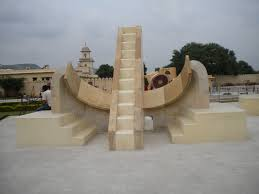
Rasivalaya Yantra
Measures Celestial Longitude. Its inclination is fixed to the obliquity of the ecliptic, independent of local latitude.
Dimension is: Obliquity of the Ecliptic $(\epsilon \approx 23.44^\circ)$
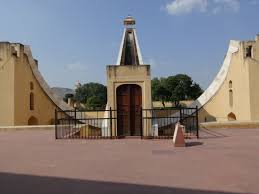
Yantra-Samrat
Combines timekeeping with polar sighting. The main structural axis (polar axis) must be set precisely.
Dimension is: Latitude $(|\phi|)$
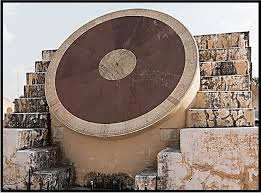
Golayantra
A physical model of the celestial sphere. Used to track motions; the rotation axis tilt must match latitude.
Dimension is: Latitude $(|\phi|)$
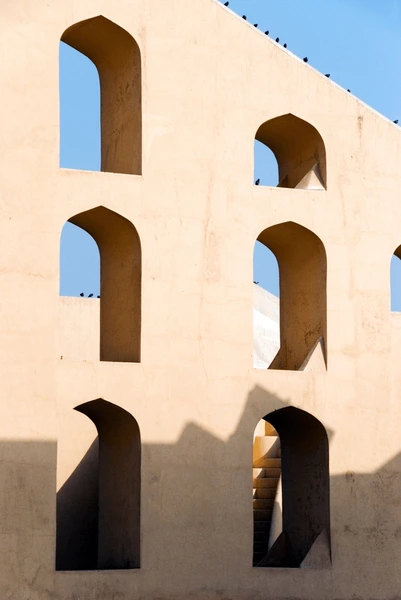
Bhitti Yantra (General)
A general term for a wall-mounted quadrant used for angular measurements, often referencing the meridian altitude.
Dimension is: Co-Latitude $(90^\circ - |\phi|)$
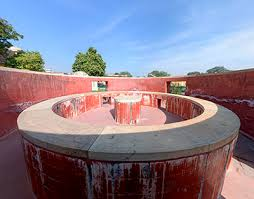
Digamsa Yantra
Used for measuring Azimuth (horizontal bearing). Requires perfect North-South alignment.
Dimension is: Alignment Angle $(0^\circ)$
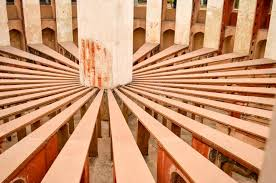
Rama Yantra
A pair of cylindrical instruments. Proportions (Gnomon Height / Radius) are critical for its scale.
Dimension is: Architect's Scale
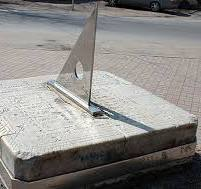
Phalaka Yantra
A portable quadrant or tablet for general angular measurements. Physical size determined by the arc's radius.
Dimension is: Architect's Scale
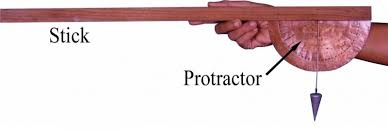
Chaapa Yantra
A 'bow' shaped instrument used to measure celestial arcs and angular separations.
Dimension is: Architect's Scale
3. The Heritage of Observation: Detailed Yantra Descriptions
Samrat Yantra (The Supreme Instrument)
The Samrat Yantra is a giant equinoctial sundial, most famously located at the Jantar Mantar astronomical observatory in Jaipur, built between 1728 and 1734 by Maharaja Jai Singh II. Considered the "Supreme Instrument," it's one of the world's largest sundials and can measure time with an accuracy of two seconds. It works by casting a shadow from its massive triangular gnomon onto two large, graduated quadrants that are parallel to the equator. It points toward the North Celestial Pole ($\text{Dhruva}$). The angle of this gnomon is the **exact measure of the local latitude** $(\phi)$. Its purpose is to measure local time ($\text{Local Apparent Time}$) with high precision.
Dhruva-Protha-Chakra Yantra (Polaris Sighting)
Instrument for sighting the Pole Star (Dhruva) to confirm the local altitude of the celestial pole. The Dhruva-Protha-Chakra-Yantra was an astronomical instrument used in ancient Indian astronomy to measure the declination of celestial bodies. It is one of many specialized yantras, or instruments, developed to observe and calculate astronomical positions. Since $\text{Polaris}$ is very close to the North Celestial Pole, its altitude is practically equal to the **local latitude** $(\phi)$. It acts as a foundational instrument to confirm the correct angular setting for all other axis-aligned Yantras.
Yantra-Samrat (Combined Axis)
Often confused with the $\text{Samrat Yantra}$, this instrument serves as a combined tool, facilitating both $\text{timekeeping}$ and $\text{polar sighting}$. The primary requirement is that its central $\text{polar axis}$ must be set precisely parallel to the Earth's axis, meaning its inclination must be equal to the **local latitude** $(\phi)$.
Golayantra (Celestial Sphere Model)
A physical, spherical model of the entire **celestial sphere** ($\text{Gola}$). It is used to track the complex motions of celestial bodies. For the model to accurately represent the sky above the observer, its $\text{rotation axis}$ must be tilted by an angle that matches the **local latitude** $(\phi)$.
Dakshinottara Bhitti Yantra (Meridian Wall)
The Dakshinottara Bhitti Yantra, meaning the "south-north wall instrument," is an ancient astronomical tool used to measure the altitude and declination of celestial bodies. It consists of a large wall aligned on the north-south axis with curved scales, and it functions by using shadows cast by rods or other objects to determine angles with great precision. This instrument is a key part of the Jantar Mantar observatories, where it was used to calculate the movement of stars, the Sun, and the Moon. It measures the maximum altitude of celestial bodies. The crucial angular setting is the altitude of the $\text{Celestial Equator}$ (at the meridian), which is fixed by the **co-latitude** $(90^\circ - |\phi|)$.
Bhitti Yantra (General Quadrant)
The Bhitti Yantra is an ancient astronomical instrument used to measure the positions, altitudes and other astronomical calculations of planets and stars. It is a large, vertical wall aligned on a north-south axis, marked with angles. The working of the instrument involves measuring the position of a celestial body with the help of a thread and nails. A general term for a wall-mounted instrument, typically a **quadrant** ($\frac{1}{4}$ circle) or **sextant** ($\frac{1}{6}$ circle), used for angular measurements. When referencing the $\text{meridian altitude}$, its measurements depend on the $\text{Celestial Equator's}$ height, making the **co-latitude** $(90^\circ - |\phi|)$ the fundamental local dimension.
Nadi Valaya Yantra (Equatorial Ring Dial)
Nadivalaya Yantra, is a version of an equinoctial sun dial quite different from the design of the Samrat Yantra. The two circular plates that are facing the north and south and are parallel to the axis of the rotation of Earth. The movement of the shadow of these rods indicates the time.This equatorial sundial uses two circular plates. The plane of these rings must be precisely **parallel to the Celestial Equator** ($\text{Nadi}$ refers to the equator). Therefore, the angle the rings make with the horizon is the **co-latitude** $(90^\circ - |\phi|)$. It directly indicates the time.
Rasivalaya Yantra (Zodiac Circle)
A Rasivalaya Yantra is a unique set of 12 astronomical instruments found at the Jantar Mantar observatory in Jaipur. Each of the 12 instruments is designed to represent one of the zodiac signs and is used to measure the latitude and longitude of celestial objects like the Sun and planets. These instruments are oriented differently to correspond to their zodiac sign and function most effectively when that sign is near the meridian. This unique Yantra measures **Celestial Longitude** (position in the Zodiac). Its inclination is fixed by the tilt of the Earth's axis relative to its orbit, known as the **obliquity of the ecliptic** $(\epsilon \approx 23.44^\circ)$. Since $\epsilon$ is a constant astronomical value, the critical dimension of the $\text{Rasivalaya}$ is fixed and **independent of local latitude**.
Digamsa Yantra (Azimuth Instrument)
The Digamsa Yantra consists of two concentric cylindrical walls surrounding a central pillar. The top surfaces of the inner and outer walls are marked in angular divisions as fine as 1/10th of a degree.The $\text{Digamsa}$ is used to determine the **Azimuth** (horizontal bearing) of celestial bodies, measuring their direction relative to the horizon. While it has no latitude-dependent angular tilt, its function relies on the foundational prerequisite of **perfect horizontal and North-South alignment** to establish the $\text{local meridian}$ reference.
Rama Yantra (Cylindrical Instrument)
Ram Yantra was constructed in 1724 by Sawai Jai Singh for measuring altitude and azimuth of celestial objects, Delhi, India.A highly complex instrument, often consisting of a pair of $\text{cylindrical}$ structures used to measure both $\text{altitude}$ and $\text{azimuth}$ (horizontal and vertical coordinates). The operational function relies on accurate measurements and **geometric proportions** (like the ratio of $\text{Gnomon Height}$ to $\text{Radius}$) that are chosen by the architect rather than being fixed by the local latitude.
Phalaka Yantra (Portable Tablet)
A phalaka yantra is a ancient Indian astronomical instrument, also known as a plane instrument, consisting of a flat, board-like surface used for measuring the altitude and azimuth of celestial bodies to determine time, track the sun's movement, and create star charts. This instrument, invented by the 12th-century mathematician and astronomer Bhāskara II, uses a pin and an index arm on the board to measure the sun's altitude, which can be used to find the time after sunrise. A general term for a small, **portable quadrant or tablet** used for basic angular measurements. The operational effectiveness relies on the **Arc Radius** chosen for its construction. It is a scale-dependent instrument, where the physical size (radius) determines the readability and precision, rather than a specific geographical angle.
Chaapa Yantra (Arc/Bow Instrument)
A chaapa yantra is an ancient Indian astronomical instrument, more accurately called the Dhanu Yantra or semicircular disk machine, used to measure the altitude or elevation of celestial objects above the horizon. It functioned like a protractor, with an arrow stick along its diameter, and helped determine things like a star's altitude or a navigator's position.The $\text{Chaapa}$ ($\text{bow}$) Yantra is an instrument shaped like an arc, typically a semicircle or a segment of a circle, used to measure $\text{celestial arcs}$ and $\text{angular separations}$ between objects. Similar to the $\text{Palaka}$, its critical dimension is the $\text{Ring Diameter}$ or $\text{Radius}$ of the arc, which is chosen by the builder based on the desired scale.